EXECUTIVE SUMMARY
Environmental molecular diagnostics (EMDs) is a collective term that describes a group of advanced and emerging techniques used to analyze the biological and chemical characteristics of environmental samples. Over the last decade, great advances have been made in adapting and applying EMDs for environmental site management. EMDs are becoming increasingly powerful, and standardized methods are being developed. As a result, their use is increasing rapidly, and a growing need exists for technical information and training on EMDs. EMDs provide additional and often unique information that supplements conventional data. The purpose of this technical and regulatory guidance document is to:
The document provides detailed descriptions of each of the major EMDs, along with case studies of their uses and recommendations regarding the appropriate uses of these techniques. In addition, appendices are included to address the frequently asked questions regarding the underlying science, including stable isotopeTwo atoms with the same number of protons but a different number of neutrons. chemistry and fundamental molecular biology, so that interested project managers, stakeholders and regulators can easily find the information needed to understand the basis for each of the individual EMDs.
Types of EMDs
EMDs can be classified into two major categories of analytical techniques: chemical techniques, specifically compound specific isotope analysis (CSIA)Analyzes the relative abundance of various stable isotopes (e.g., ¹³C:¹²C, ²H:¹H). Degradation processes can cause shifts in the relative abundance of stable isotopes of the contaminant; changes in isotopic ratios can be measured., and a variety of molecular biological techniques (MBTs). CSIA measures the amounts of stable isotopesForms of an element that do not undergo radioactive decay at a measureable rate. (typically carbon, hydrogen, or chlorine) in contaminants to determine the extent of specific chemical and biochemical reactions impacting the contaminant. As a contaminant degrades through natural or engineered processes, the relative amount of each stable isotope in the contaminant can change. In contrast, the isotopic composition of contaminants is largely unaffected by processes such as dilution that do not result in degradation of the contaminant. CSIA therefore can be useful for answering several important questions regarding a chemical’s source, degradation mechanisms, and rate of degradation.
MBTs evaluate the types, abundance, and biochemical capabilities of microorganisms present in the environment. Often, the microorganisms responsible for the degradation of specific contaminants cannot be detected and quantified by conventional methods and MBTs can overcome these limitations. Several types of MBTs are available - some can be used to detect known microorganisms, others are also useful for quantification, some can be used to determine whether microorganisms are actively degrading specific contaminants, and some can identify currently unknown microorganisms involved in degradation.
To date, the most commonly used MBTs are polymerase chain reactionMakes copies of a specific DNA sequence within a target gene of microorganisms that can be further analyzed. (PCR), quantitative PCR (qPCR) and reverse transcriptase-qPCR (RT-qPCR), and DNA microarrays. However other MBTs have uses as well, including fluorescence in situ hybridization (FISH)Detects the presence of targeted genetic material in an environmental sample and estimates the number of specific microorganisms or groups of microorganisms., enzyme activity probes (EAPs)Transformation of surrogate compounds (probes) resembling contaminants produces a fluorescent (or other distinct) signal in cells which is then detected using a microscope. and stable isotope probing (SIP)A synthesized form of the contaminant containing a stable isotope (e.g., ¹³C label) is added. If biodegradation is occurring the isotope will be detected in biomolecules (e.g., phospholipids, DNA).. There are also several potentially useful microbial fingerprinting techniques, including phospholipid fatty acid (PLFA) analysisA laboratory analytical techniques that differentiate microorganisms or groups of microorganisms based on quantifying PLFA groups., denaturing gradient gel electrophoresis (DGGE)Type of gel electrophoresis used to separate mixtures of PCR products based on the melting point which is reflective of the DNA sequence. DGGE is used to generate a genetic fingerprint of the microbial community and potentially identify dominant microorganisms., and terminal restriction fragment length polymorphism (T-RFLP)A nucleic acid (DNA or RNA)-based technique used to generate a genetic fingerprint of the microbial community and potentially identify dominant microorganisms..
EMDs have application in each phase of environmental site management, including site characterization, remediation, monitoring, and closure activities (See Figure ES-1). EMDs can provide unique information valuable in conjunction with more conventional data.
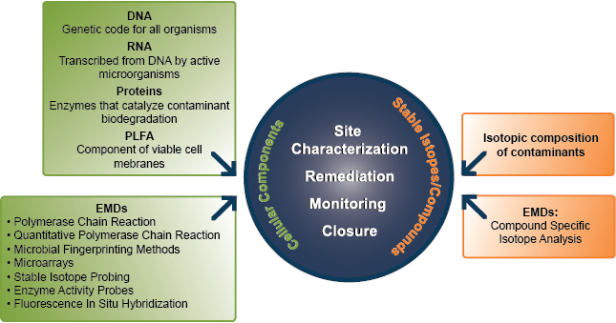
Figure ES-1. Overview of EMDs.
Using EMDs
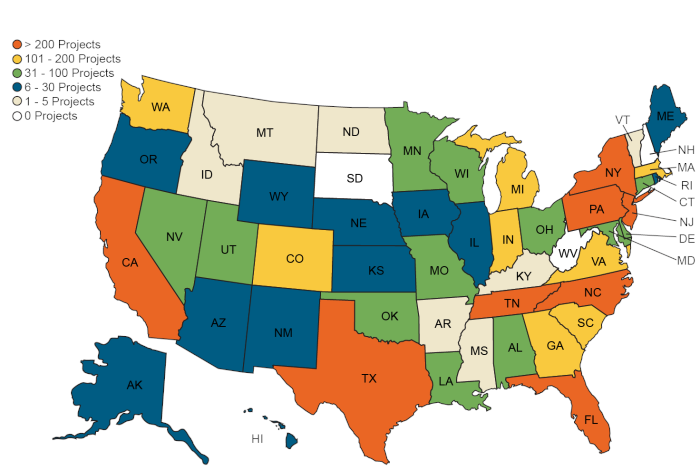
EMDs have been used at hundreds of environmental cleanup sites in the US (and also at sites around the world). Figure ES-2 includes cumulative data for numbers of projects by state from 2009 to 2012. The data are from two commercial laboratories, so the data may not fully represent the actual number of EMD projects completed during that time. The states were assigned to the projects based on the information available to the laboratories. There is uncertainty in some of the project locations because of client confidentiality. The map is intended to provide a relative understanding of the usage of EMDs at this time, and not to provide definitive numbers of projects.
Figure ES-2. EMD projects by state.
EMDs can provide the following benefits:
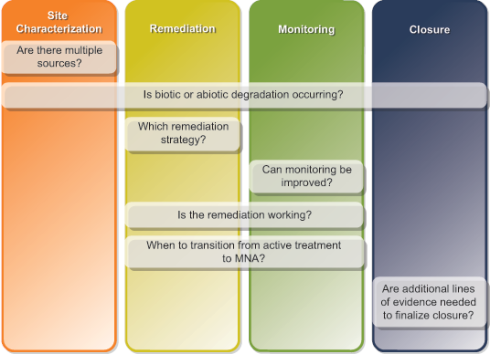
Figure ES-3 describes potential uses of EMDs in each phase of site management.
Figure ES-3. Potential uses of EMDs in site management.
The key information available from such tools includes:
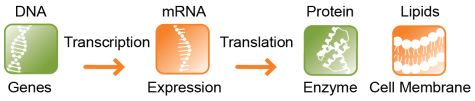
To select the appropriate EMDs, it is important to understand the connections between the information provided by DNA-based analysis, RNA analysis, and stable isotope-based analysis. In general, the genes of microbes (and other organisms) are composed of deoxyribonucleic acid, or DNA. DNA can be transcribed into RNA, and ultimately translated into enzymesAny of numerous proteins or conjugated proteins produced by living organisms and facilitating biochemical reactions (based on USEPA 2004a). (and other proteins) that degrade the contaminant (see Figure ES-4). Thus DNA-based analyses (such as PCR, FISH, some fingerprinting methods, and microarrays) can determine if microorganisms with the potential to biodegrade target contaminants are present at a site, and in some cases (notably qPCR), the abundance of the target microorganisms. RNA-based analyses (such as RT-qPCR, FISH, microarrays, and some fingerprinting methods) or analyses that identify the end product of specific enzymes (such as EAPs) can show that biodegrading organisms are actively expressing biodegradation genes.
One of the most frequent uses of EMDs is to verify that natural or enhanced biodegradation can occur, or in fact is occurring, in situ. Some EMDs can be used to estimate biodegradation rates. CSIA in particular can be very useful for this purpose. Care must be taken, however, in extrapolating rates both spatially and temporally. Additionally, EMDs that indicate number of geneA segment of DNA containing the code for a protein, transfer RNA, or ribosomal RNA molecule (based on Madigan et al. 2010). copies, or count the number of organisms in a given sample, could potentially be used to infer degradation rates, or at least to conclude that useful rates are occurring or that native or added organisms are increasing in number over time. However, there is currently no method to calculate degradation rates from the number of organisms or gene copies in a sample.
Figure ES-4. Flow of information within cells.
EMD Issues
Project managers, stakeholders and regulators must be concerned with the quality of EMD analyses and the proper interpretations of the results. This guidance includes recommendations on standard practices that have been developed recently to ensure that samples are collected and analyzed appropriately. Using the guidance presented here, project managers, regulators and stakeholders can evaluate plans for EMD analyses, the quality of EMD results, and the data interpretations.
EMD plans and analyses should be based on a sufficient number of samples, taken at appropriate locations and times, using appropriate techniques, and including appropriate documentation and QA/QC controls. The number of samples needed for a given site will be a function of site conditions including geology, hydrogeology, geochemistry, and contaminant distribution. A successful sampling program will incorporate these parameters in a site-specific sampling plan. Generally, vadose zone biology is more location-specific because microbial transport (and thus distribution) depends on excess water. With less water available, more samples may be required to characterize a smaller area. Since microbial diversityMicrobial diversity can have many definitions but in this context generally refers to the number of different microbial species and their relative abundance in an environmental sample (Nannipieri et al. 2003). in soils and sediments can vary on a millimeter scale, homogenization and multiple samples are desirable.
Samples may be collected by either active or passive sampling techniques, from groundwater or solid materials. For some bacteria (e.g., DehalococcoidesDehalococcoides is a genus of organohalide-respiring bacteria (for example, bacteria that use chlorinated solvents as metabolic electron acceptors) within the phylum Chloroflexi, in the domain Bacteria, and currently represented by a single species, Dehalococcoides mccartyi (Dhc). This species is the only one known with strains that dechlorinate dichloroethenes (DCEs) and vinyl chloride (VC) to ethene and inorganic chloride., perchlorate degraders) active sampling of groundwater alone will be useful because a significant fraction of the bacteria can be found in the aqueous phase (see Section 10.4.2). However, other bacteria may be primarily attached to the aquifer solids, and groundwater analysis alone may not be appropriate. When sampling groundwater, most EMDs require filtration of the sample to collect concentrated biomass for analysis. Various biomass extraction/filtration approaches are available for collecting active microbial biomass from environmental media. Passive microbial sampling devices are groundwater sampling tools (for example, biofilm coupons, in situ microcosms, groundwater dialysis chambers, porous beads, Bio-Trap® samplers) that facilitate colonization of subsurface microorganisms onto a retrievable matrix. Passive microbial sampling devices may be very useful for assessing activity in situ, but the results may only be semi-quantitative, since it is difficult to relate microbial concentrations in the groundwater or aquifer matrix to those detected on the passive microbial sampling device (See EMD Sampling Methods Fact Sheet and Section 10.4.3).
Survey Results
A survey of regulators, consultants and stakeholders indicated that a lack of standardized QA/QC guidelines is one of the primary concerns regarding use of these emerging techniques (see Appendix B Survey Results). Recent QA/QC guidance is available from USEPA for the use of CSIA, as well as for PCR-based methods. Much of this latter guidance also is applicable to other MBTs as well.
This ITRC document includes several QA/QC considerations that should be part of any plan for the use of EMDs. However, if EMDs are to be used at a site, it is important that the regulator be involved as early as possible, to allay such QA/QC concerns. During the initial meeting, a draft work plan should be available, and should include:
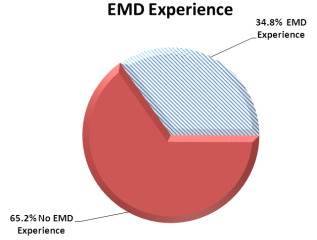
Finally, EMD team members and most of those surveyed agree that education is the key to more widespread use of EMDs in the environmental site management field. Figure ES-5 includes the results from the respondents to the survey when asked about their EMD experience.
Figure ES-5. Experience with EMDs survey results.
As regulators become better educated and more comfortable with their use, guidance and regulations specific to EMD use will be developed. Until state documents are developed, this ITRC document and the related Fact Sheets developed by this team will serve as the most comprehensive resources available for regulators, consultants, and the general public.